
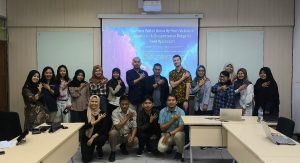
The Department of Geological Engineering, Faculty of Engineering, Universitas Gadjah Mada (UGM), organized a guest lecture entitled “Water Security from Volcanic Aquifers: A Groundwater Ridge-to-Reef Approach” on Wednesday, January 21, 2026. The event was held in a hybrid format, with onsite participation at Meeting Room 2.1 (2nd Floor), Department of Geological Engineering, FT UGM, and online via Zoom.
The lecture featured Alix Toulier, Ph.D., a hydrogeologist and researcher from the HydroSciences Laboratory, University of Montpellier, France, as the main speaker. The event attracted 30 onsite participants and 58 online participants, reflecting strong interest in groundwater and water security issues in tropical volcanic regions. Participants came from a wide range of backgrounds, including government institutions and research organizations such as the Center for Groundwater and Environmental Geology (PATGTL), BRIN, the Ministry of Public Works and Housing (PUPR), the Central Java Provincial Energy and Mineral Resources Office (ESDM), and the Groundwater Conservation Agency (BKAT). The audience also included representatives from PAAI (the Indonesian Groundwater Association), the NGO Jagasemesta, universities such as ITB, UNDIP, UB, and UNPAD, the private sector (AQUA Danone), as well as lecturers, undergraduate students, master’s students, and doctoral candidates from the Department of Geological Engineering at UGM.
In his presentation, Alix shared his research experience on groundwater systems in various volcanic tropical Islands, including La Réunion Island, Hawai‘i, and Indonesia. He emphasized the importance of understanding groundwater systems using a ridge-to-reef approach, which links upland recharge areas to downstream and coastal environments. He presented research findings on groundwater recharge–discharge quantification, the role of clouds in recharge processes, groundwater modeling of coastal pollutants, and recent advances in Decision Support Tools for volcanic islands.
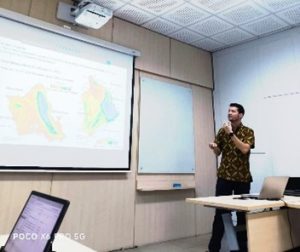
Following the presentation, the discussion session was highly interactive. Participants raised questions regarding the availability and reliability of rainfall data, the influence of cyclonic events on groundwater recharge, and the role of extreme climate variability in volcanic aquifer systems. Several questions focused on how rainfall data can be integrated with field observations to distinguish direct rainfall recharge from other recharge processes.
A significant portion of the discussion addressed cloud water inputs. Participants expressed particular interest in how Cloud Water Interception (CWI) can be quantified, its relative contribution compared to rainfall, and the challenges of incorporating CWI into a comprehensive understanding of hydrological processes. Questions also explored how vegetation type, elevation, and climate dynamics influence the magnitude of CWI-derived recharge.
Further discussion extended to numerical groundwater modeling, including how rainfall, CWI, and groundwater flow processes are represented in models, as well as the limitations imposed by data availability and modeling assumptions. Additional topics included aquifer thickness, geological controls on groundwater storage and flow, and their implications for groundwater quality, particularly water–rock interactions and vulnerability to contamination. The final discussion focused on adapting Decision Support Tools to tropical volcanic environments, aiming to translate scientific data into accessible information and support the prioritization of future actions. Alix reemphasized that an integrated understanding of climate, vegetation, hydrological processes, aquifer systems, and socio-economic practices is essential to support water security in volcanic regions, particularly in the face of climate change.
The guest lecture was considered highly relevant and opened opportunities for further discussion among academics, researchers, practitioners, and policymakers.
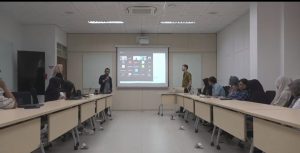
Closing the event, Prof. Heru Hendrayana expressed his appreciation and gratitude to all speakers and participants, both onsite and online. He noted that the strong enthusiasm and active discussions highlighted the critical importance of groundwater recharge processes in supporting water security, especially in volcanic aquifer systems. According to him, research on Cloud Water Interception (CWI) presented during the lecture represents an intriguing topic that remains relatively underexplored, despite its significant role on groundwater recharge. Prof. Heru also emphasized that the groundwater ridge to reef approach has not yet been widely applied in groundwater studies in Indonesia, and that this perspective could provide new insights into the connectivity of groundwater systems from upland areas to coastal zones, as well as reveal the potential of coastal groundwater resources that have so far received limited attention.
As a follow-up to this seminar, Alix Toulier is currently developing a research proposal focused on water security in Indonesia. This project is intended to be conducted through a collaboration between the French National Research Institute for Sustainable Development (IRD) and Universitas Gadjah Mada (UGM). The collaboration is expected to strengthen international research partnerships and support the development of sustainable groundwater management strategies in Indonesia to secure access to safe drinking water.
Alix remains open to further discussions and collaborations and can be contacted via email at alix.toulier@umontpellier.fr
Writer: Narulita Santi dan Faridha Aprillia
Humas Departemen | Januari 2026